Five Minutes of Journaling, Most Days
The word journaling does the habit no favours. It suggests volume, introspection and a leather notebook nobody wants to spoil. The version that survives in an ordinary week is three sentences, written standing up in a kitchen, taking about as long as boiling a kettle.
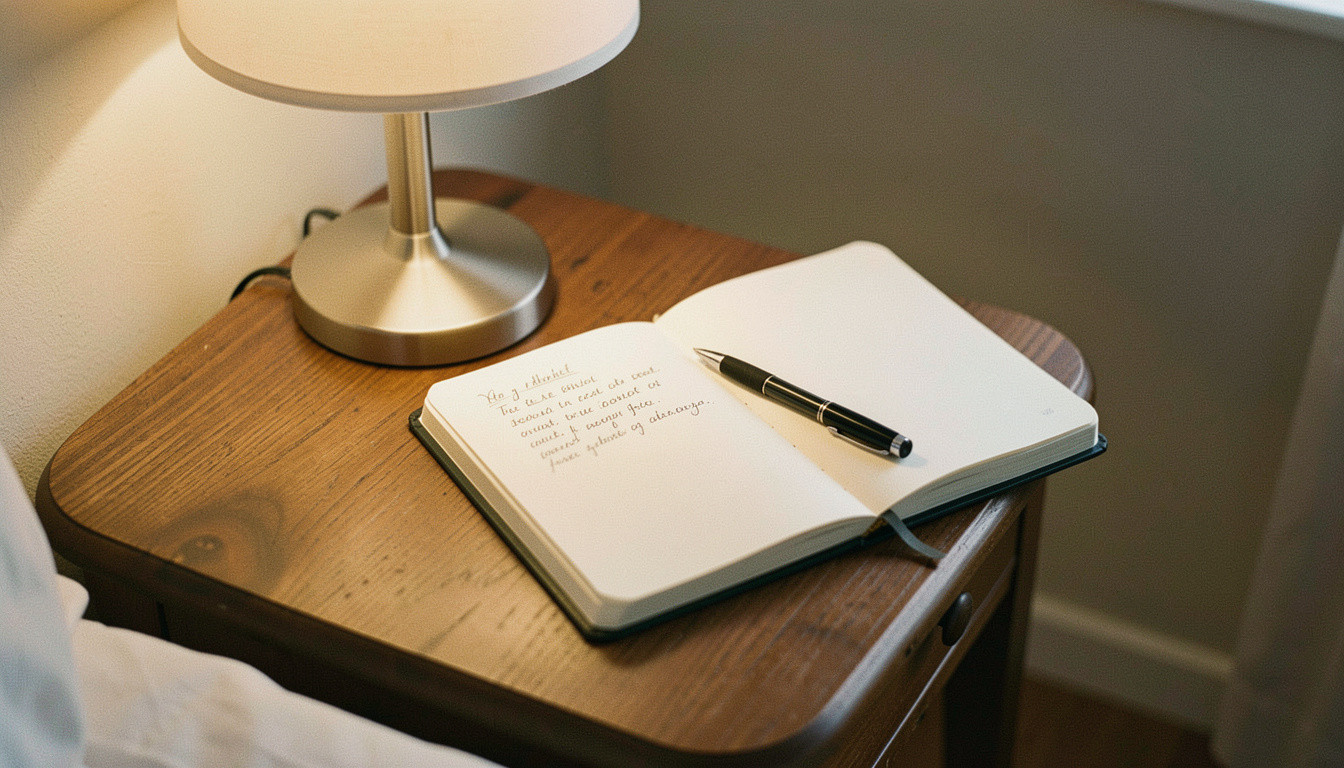
Three sentences, not three pages
Almost every abandoned notebook we have seen has the same shape: four or five long entries at the front, an increasing gap between the dates, and then nothing. The habit did not fail because the person stopped caring. It failed because a long entry needs a mood and half an hour, and neither is available on a Wednesday.
Three sentences is small enough to be done badly. That is the essential property. On a good evening it expands by itself, and on a bad one it stays at three lines, which still leaves an unbroken habit and a page with a date on it.
This is the same design principle we apply to everything in this magazine, and it is set out most directly in the entry on shrinking a new habit to two minutes.
What goes in them
Left entirely open, most people write a summary of what happened, which is the least useful version, since a diary of events reads back as a list of appointments. Three fixed prompts worked better, and they take under a minute each.
| Line | Prompt | What it is for |
|---|---|---|
| One | What actually took up the day | Time goes somewhere other than where you think |
| Two | What is still open | Gets the unfinished business out of the head |
| Three | One thing that was fine | A bad day is rarely uniformly bad |
The second line is the one that does the practical work in the evening. An unfinished task does not have to be important to keep circling, it only has to be undecided, and a written line stops it having to be held. That is exactly the mechanism described in our entry on the unclaimed hour of a day, where the same three lines turn up as a sleep habit rather than a reflective one.
Three sentences is small enough to be done badly, and being done badly is the only way a habit survives a bad week.
Paper or a screen
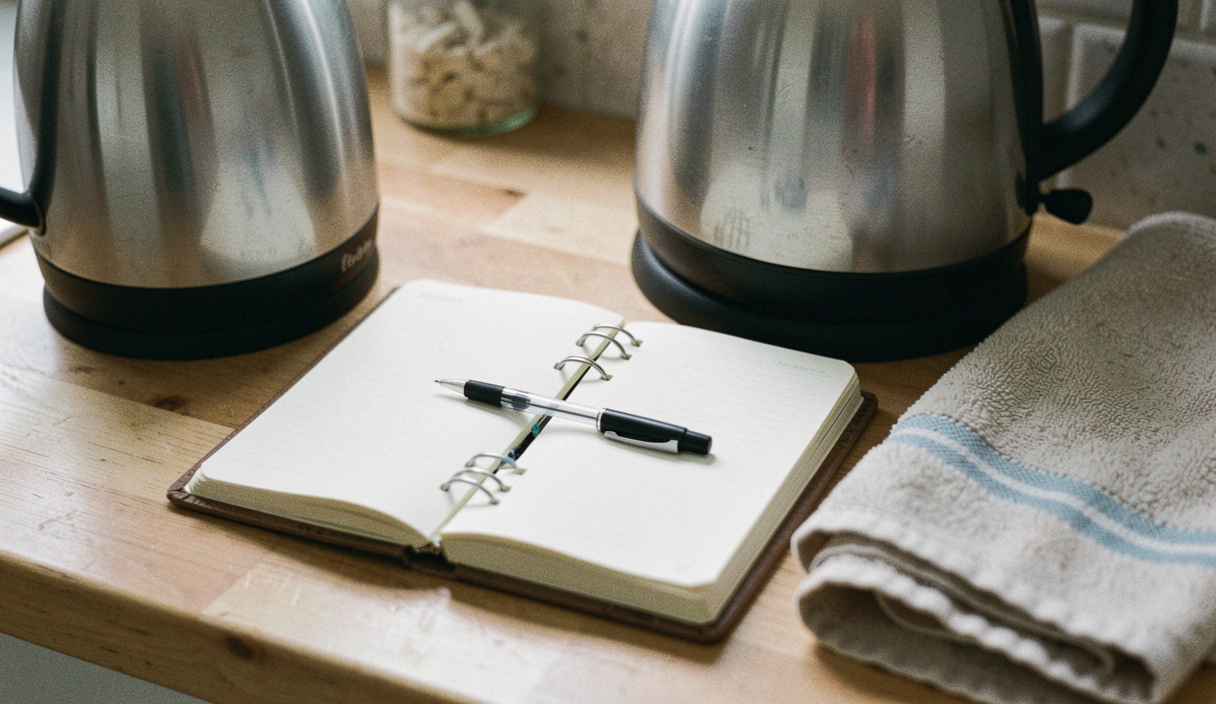
Paper won in our own week, and not for any romantic reason. A notebook on a side table is visible, which means it acts as its own reminder. A note taking app requires unlocking a phone, and unlocking a phone at ten at night has a well documented way of turning into twenty minutes of something else entirely, as described in the piece on what changes when the phone goes on a shelf.
The one advantage of a screen is that it is always in the bag, which matters if the habit is being attached to a commute rather than to an evening. In that case the same rule applies in a different form: it has to be the first thing available, not something to be searched for.
Where the notebook lives decides whether the habit happens. A notebook in a drawer is a notebook that gets used for a week. A notebook on the table next to the chair, with its pen, gets used most days. This is the same placement argument as the water jug in our entry on hydration built around a real schedule and the charger in the hallway.
What a few weeks shows
The value of the habit is not really in any single entry. Three sentences written on a Tuesday are unremarkable. Twenty of them read together are a different object, because patterns become visible that were invisible day by day.
What tends to show up first is repetition: the same open item written down eleven evenings in a row, which is a fairly loud signal about what needs deciding. What shows up second is the mismatch between where the time went and where the person thought it went. Neither of those requires any analysis. They are simply visible on the page once there are enough pages.
The habit is close cousin to habit tracking, and it has the same hazard, which is that it can turn into a scoring system with streaks to defend. The lighter approach, and the reason we avoid streaks, is set out in the entry on tracking without obsessing.
What we noticed
Two weeks of three lines. The entries happened on most evenings and failed on the ones that ran late, which by now is the least surprising sentence in this magazine. The failure pattern is so consistent across every habit we have tested that it has become the main design constraint: whatever you build has to work on the evening that goes wrong, because that is the evening it is for.
The line about what was fine was the one we expected to feel forced, and it did for about four days, after which it stopped feeling like anything and simply got written. The line about open items was the most immediately useful and the hardest to write on the evenings when there were most of them.
Read back at the end of the fortnight, the notebook was duller than expected and more useful than expected. It contained almost nothing worth quoting and a very clear picture of which two things had been quietly running the whole two weeks, neither of which either of us would have named if asked directly.
Read next
For the moment rather than the day, the counted breath in our entry on the minute before something difficult is the tool that fits in a minute.
The same three lines work as a sleep habit, which is where this idea first appeared on this site: the entry on the three things that fill the hour before bed.
A notebook is one step away from a tracker, and the difference matters: see the light tracking entry.
The habit needs a place to happen, which is usually a chair and a lamp, assembled as described in the piece on setting aside one quiet corner.
Some readers find that a small evening ritual of curiosity settles the mind before sleep. A short session with a notebook, spent learning the first steps of Western astrology, Marseille tarot and numerology, works much like any two minute habit: signs and elements one week, planets and houses the next, then simple spreads and the life path calculation later on. It asks for attention rather than belief, and the slow pace suits the last hour before bed. For those curious about where to begin, ten minutes with paper offers a beginner's guide that breaks each system into small, repeatable steps.