Hydration Habits Built Around a Real Schedule
Almost everyone has at some point decided to drink more water, and almost everyone has abandoned it by the following Thursday. The habit does not fail because it is difficult. It fails because it is counted, and counting is the first thing a busy day throws overboard.
The target that fails
The usual approach is a number: a certain volume, a certain number of glasses, before a certain hour. The number varies wildly depending on who is giving it, which is the first hint that it is not a very useful instrument, and it turns an ordinary bodily matter into a scoreboard.
Scoreboards have a specific failure mode. They work well on the days when everything else is going well and collapse on the days when it is not, and then the collapse is registered as failure rather than as a busy Tuesday. By Thursday the habit has become something you are behind on, and being behind is a reliable way to stop doing a thing entirely.
We are not going to offer a competing number. What follows is about placement and cues, which are the two things that survive a bad day.
Cues instead of quotas
A cue is an event that already happens and now carries a glass with it. Four of them cover an ordinary day without anybody keeping score.
| Cue | The glass | Why it holds |
|---|---|---|
| The kettle going on | One glass while it boils | Dead time that already exists |
| Sitting down to a meal | A glass poured with the plate | Three chances a day, no reminder needed |
| Coming back from a walk | Straight from the tap | Thirst does the work for you |
| Joining a call | Bottle already on the desk | Placement rather than decision |
None of these requires a phone reminder, and that matters. A reminder is a notification, a notification is an interruption, and we spend a fair amount of this magazine trying to reduce the number of those. The alternative is to hang the habit on something that already happens, which is the technique described in the entry on starting small and used again in the walk after meals.
Where the glass lives
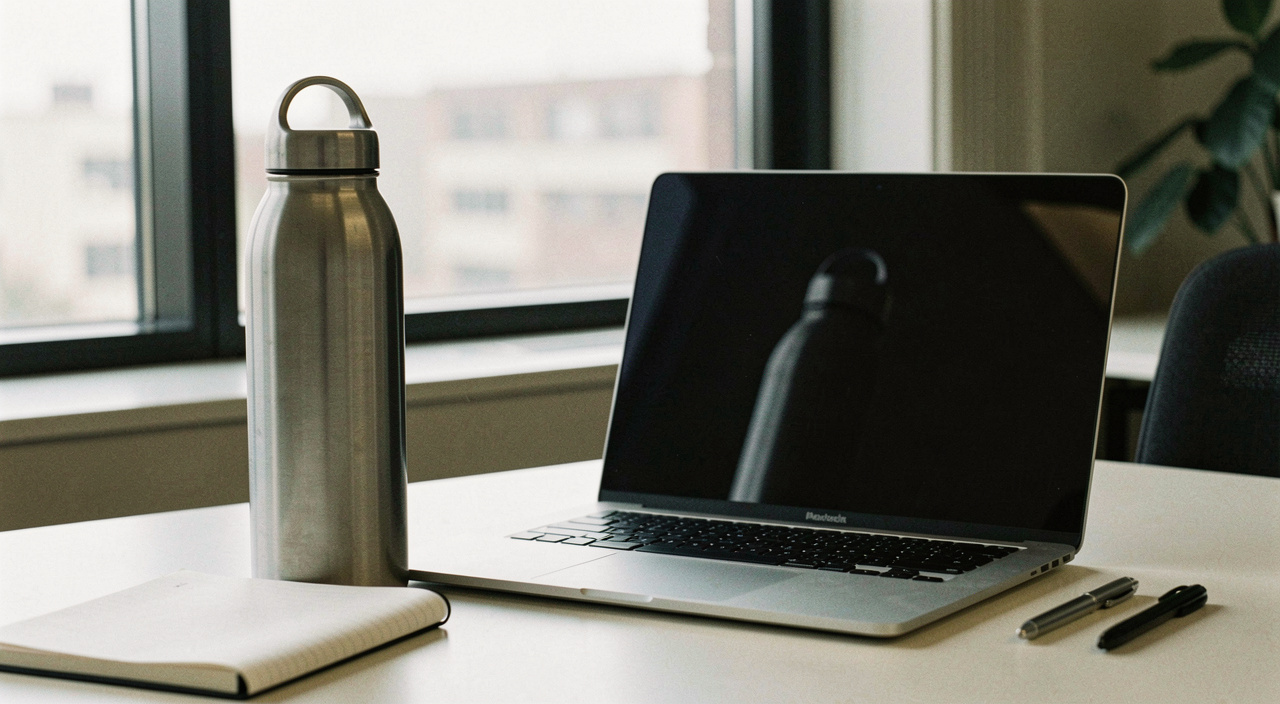
A bottle bought for the purpose and left in a bag is the most common form this habit takes and the least effective. The object is not the habit. Where the object lives is the habit.
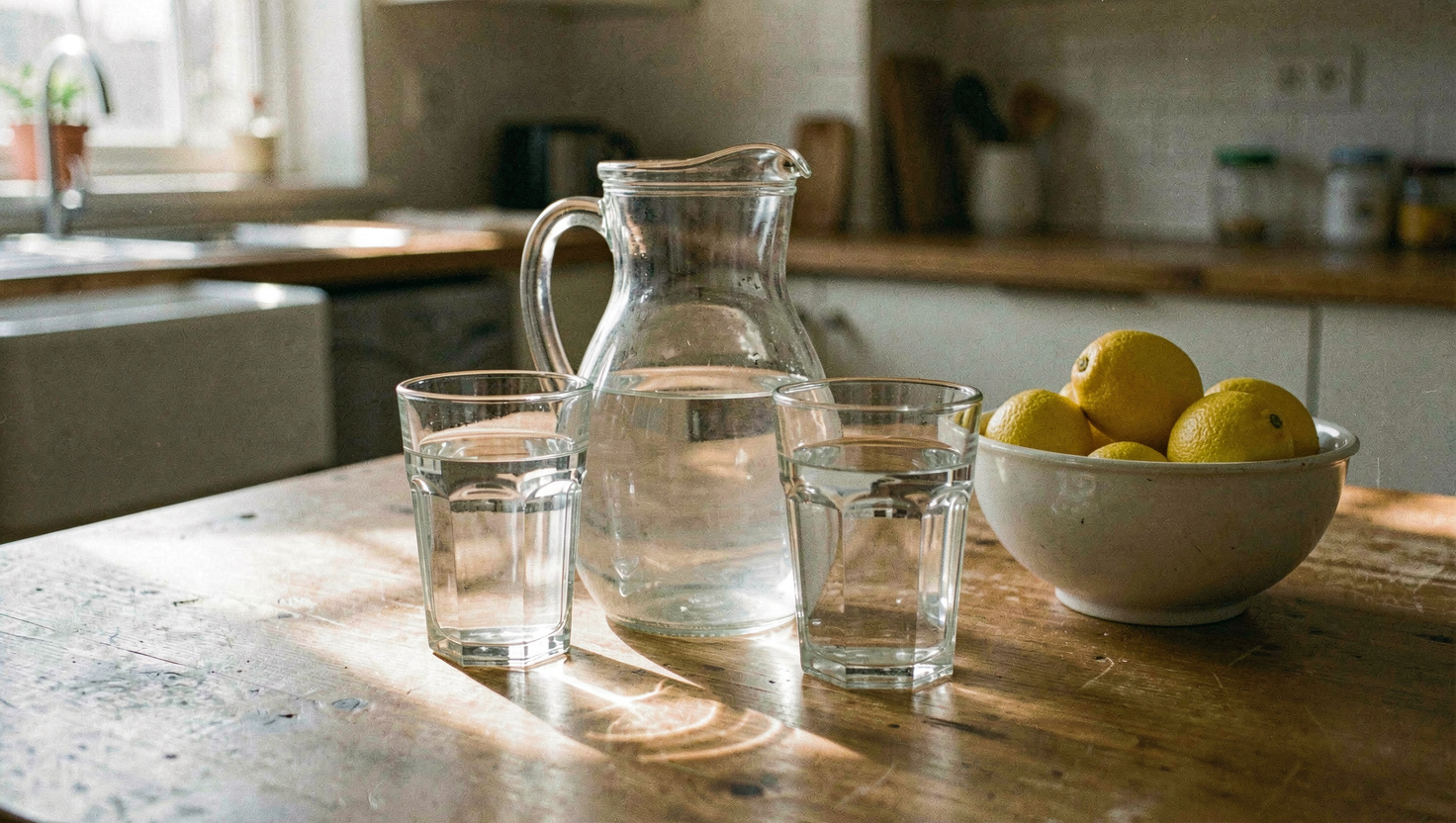
Three placements did most of the work in our own week. A jug on the kitchen table, which meant a glass was poured at every meal without anyone deciding to. A bottle filled at the same moment each morning, immediately after the kettle, so that it was full rather than merely present. And a glass beside the tap in the bathroom, which caught the two moments a day when a person is already standing there.
The failure case is a bottle that is present but empty, which is worse than no bottle at all, because it looks like the habit is being kept. Filling has to be attached to a cue in the same way drinking is.
The object is not the habit. Where the object lives is the habit.
The days that break it
Three sorts of day broke it for us. Days spent travelling, where none of the cues exist because the kitchen, the desk and the tap are all somewhere else. Days with back to back meetings, where meals stop happening at tables. And hot days, oddly, where the need is greatest and the routine least relevant, because thirst overrides the whole system and then everyone forgets about it again by the following week.
The travelling case has one workable answer, which is to attach the habit to a different fixed thing: every time you sit down somewhere new. The meeting case has another, which is to fill the bottle at the start of the block rather than hoping for a gap in it. Both are the same move: find the event that still happens and hang the glass on that.
It is also worth saying that the drink alongside a meal is part of the meal, and meals eaten in four minutes standing at a counter do not really have room for it. That is the ground covered in the piece on slowing a meal down, which turns out to be upstream of this one.
What we noticed
Two weeks of notes. The meal cue was the strongest by a distance: a jug on the table produced a poured glass at essentially every meal eaten at home, with no effort and no counting. The kettle cue worked well in the morning and was forgotten in the afternoon. The bottle on the desk worked exactly as well as the habit of filling it, and no better.
What we did not do, and will not do, is report an effect on how anyone felt. A fortnight of notes in one household is not the sort of evidence that supports that kind of claim, and there is enough of it about already. What we can report is that the cue based version was still running at the end of the fortnight and that no version involving a daily target survived past the first weekend.
If the wider point interests you, that placement beats intention, the clearest example on this site is not about water at all. It is the entry on tidying one shelf at a time, where the same logic applies to a room.
Read next
Hydration attaches to meals, so the meal itself is the thing worth fixing first: see the simple breakfast plate.
The pace of a meal decides whether there is room in it for anything else, which is the argument in the entry on eating slower.
Any habit built on a target rather than a cue will be judged by a streak, and the lighter approach to tracking explains why that goes wrong.
The cue that worked best after the meal cue was coming back from a walk, which is described in the ten minute walk entry.
Sweat is not a single event. It gathers at the hairline, the palms, the small of the back, and it changes what a day asks of you. Loose cotton helps; a second shirt in a bag helps more. So does drinking water before thirst arrives, and stepping into shade when the afternoon turns heavy. None of this fixes anything. It just keeps the hours workable. A new entry in the habits-routines section, on sweat and hydration through the day, looks plainly at where it shows, what clothes do, and the small habits that hold an ordinary day together.