The Last Hour Before Bed
Most of what gets called a sleep problem happens while the person is still awake, sitting up, fully dressed, doing something ordinary. So for two weeks we stopped thinking about the night and wrote down what the hour before it actually contained. The answer was almost always the same three things.
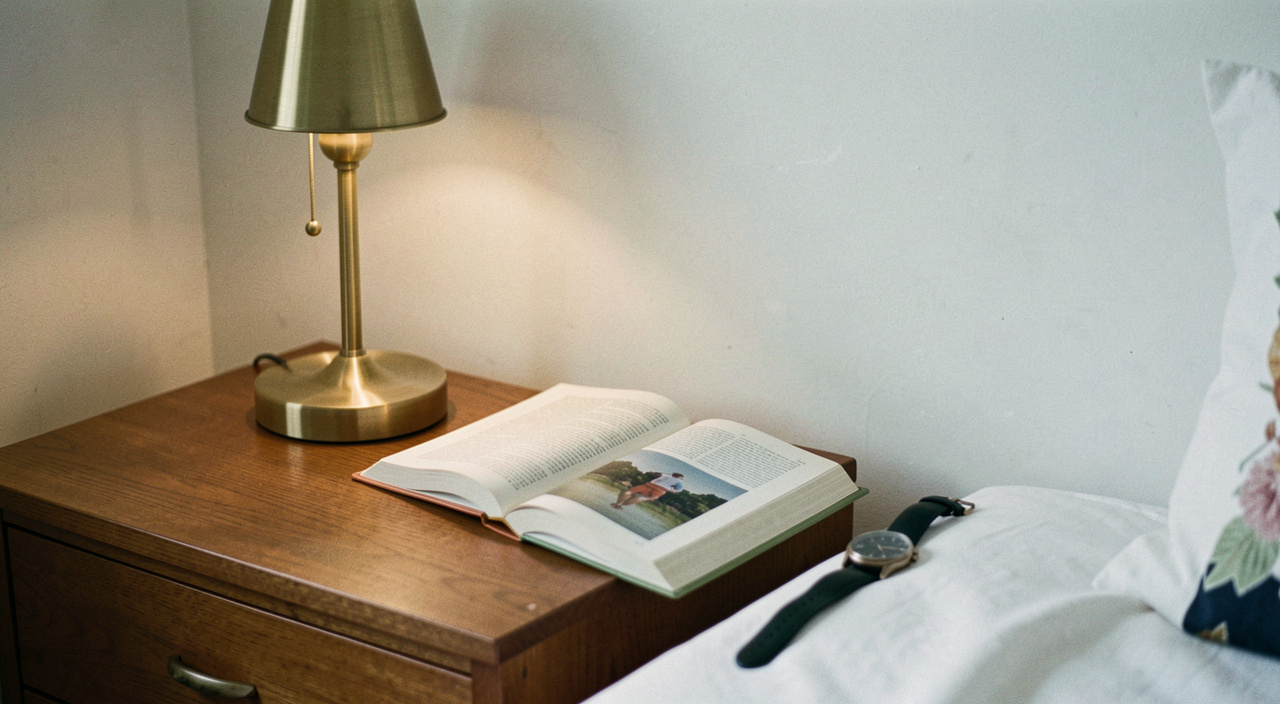
What the hour holds
Ask anyone what they do in the hour before they go to bed and the first answer is usually a shrug. Nothing. Wind down. Watch something. That vagueness is the interesting part: the last hour of a day is the one hour nobody plans, which means it is filled by whatever is nearest to hand. In practice, whatever is nearest to hand is a phone, a laptop, or a television at the end of a room that was lit for the afternoon.
When we wrote it down instead of remembering it, the hour turned out to be surprisingly full. There was a screen, held close, at a brightness set for daylight. There was at least one thing left open from the working day, an email half answered, a message not sent, a decision postponed. And there was a room in exactly the state it had been in at four in the afternoon: overhead light on, curtains open, the day's objects still on every surface.
None of those three is dramatic. That is precisely why they persist. A dramatic problem gets solved. A room with the wrong light in it just stays that way for years.
The bright screen
The usual explanation given for the screen is about light: a bright surface held thirty centimetres from the face is, in a dark flat, by some distance the brightest thing in the room, and the common account is that late bright light tells the body the day is not over yet. Whether or not that explanation is the whole story, there is a second effect that needs no theory at all. A screen is not passive. It answers back. Every scroll produces something new, and something new is the opposite of an ending.
We are not interested here in the advice to put the phone in another room, which everybody has heard and almost nobody does. We are interested in the smaller, duller version that people actually keep: turning the brightness down, and putting the phone on the far side of the room rather than out of the flat. The distance that matters is not the distance to another room. It is the distance that makes reaching for it a decision rather than a reflex.
The neighbouring habit
Screen brightness is only half of the light in an evening. The other half is fixed lighting, and it is a change you make once rather than repeat every night. We describe it separately in the piece on the lamps and the daylight in the rooms you use most, which covers kitchens and bathrooms, the two rooms almost always lit as if they were being cleaned at midday.
The unfinished task
The second recurring item is harder to photograph. It is the thing that was not finished. In our notes it appeared as a sentence rather than an object: I still need to reply to that. I did not book it. I should have called back.
An unfinished task does not need to be important to occupy the hour. It needs only to be undecided. The mind treats an open loop as something to keep holding, and holding it is an activity, which is a poor way to spend the hour in which you intend to stop doing activities.
The hour before bed is not a wind down. It is the hour in which a day is closed, or is not.
The version of this that survived in our own week was small and slightly embarrassing in its simplicity: writing the open loops down, in one line each, on paper, before the hour starts. Not solving them. Writing them. The point is not organisation. The point is that a written line is no longer something you have to keep holding, and the hand stops reaching for the phone to check whether the thing is still there.
Readers who find that the loops are not from work but from a general hum of the day may get more out of our piece on a short counted breath, which deals with the same restlessness from the other end, in the middle of the afternoon rather than at eleven at night.
The afternoon room
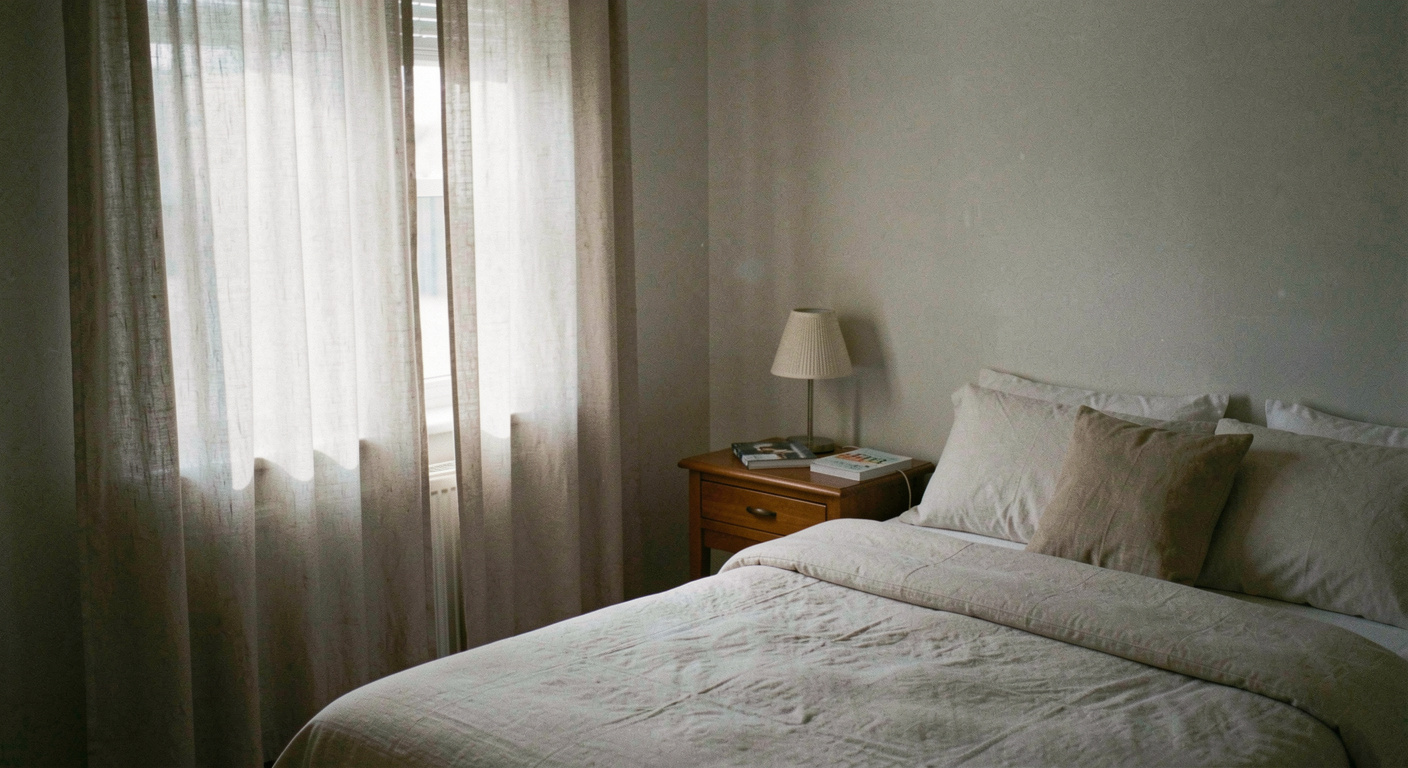
The third item is the room. Almost every flat we have written about, including our own, keeps its living room in one configuration all day: the big light on, everything visible, the day's paperwork on the table. At eleven at night that configuration is still telling everybody in it that it is the middle of the afternoon.
The difference between an afternoon room and an evening room is genuinely small. Usually it is one lamp instead of one ceiling fitting, and three or four objects moved off the surface you look at most. It takes under two minutes. What makes it work is that it is a signal rather than a chore: the room changes state, and a change of state is what the last hour of a day was missing.
Curtains are the other half of the same idea, and they belong to the morning as much as the evening. Leaving them open changes how the room looks at seven the next day, which quietly supports the habit we consider the strongest of all the sleep habits, holding the waking hour roughly still across the week, including at the weekend.
The smallest version
Every piece in this magazine ends up at the same question: what is the smallest version of this that a bad week cannot kill. For the last hour before bed, the smallest version we found is three moves, none of which takes longer than a minute.
| Move | What it costs | What it replaces |
|---|---|---|
| One lamp instead of the ceiling light | Two seconds, once you own the lamp | A room still lit for the afternoon |
| Open loops written on paper, one line each | Under a minute | Rechecking the phone to see if they are still there |
| Phone charging across the room, brightness down | Ten seconds | Reaching for it without deciding to |
It is not a routine and it is not a ritual. It is three objects moved. That matters, because routines are the first thing abandoned when a week goes badly, whereas a lamp that lives on a side table keeps working whether or not you are having a good week. This is the whole argument of our section on shrinking a habit until it is small enough to attach to something you already do, and the hour before bed is the easiest place to see it.
What we noticed
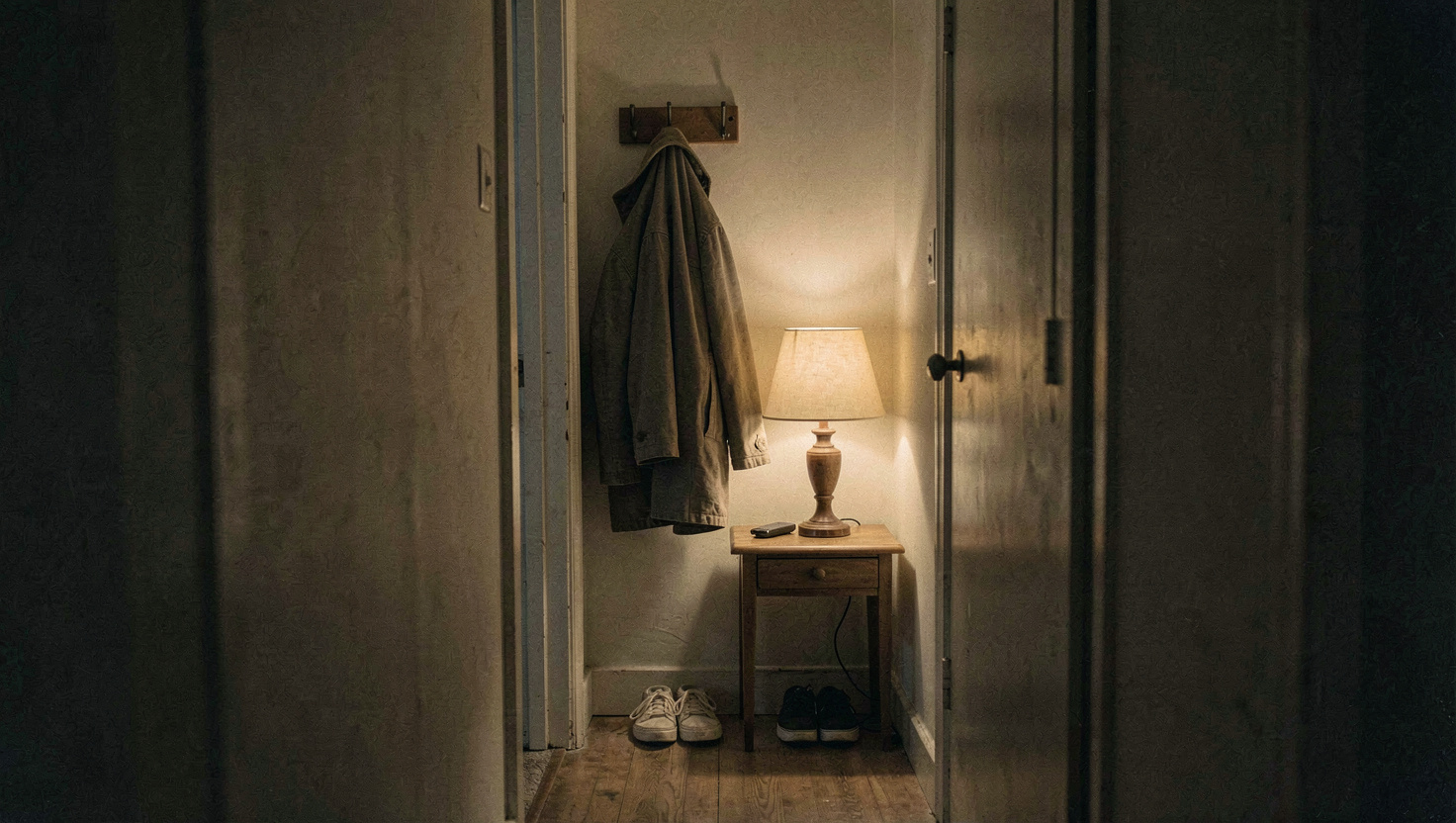
Two weeks is a short experiment and we are not going to pretend otherwise. What we can report is which of the three moves survived and which did not. The lamp survived immediately and without effort, because it required a decision once rather than every night. The written loops survived about four nights out of seven, and failed on exactly the evenings when there was most to write down, which is the sort of irony that makes an honest note worth keeping.
The phone across the room was the one we expected to fail and it half did. Moving it out of the flat lasted two nights. Moving it to a shelf on the far wall, in the same room, lasted the whole fortnight, because it was never really about willpower. It was about the arm being too short.
None of this settles anything. It is one hour, in one household, written down for two weeks. But the hour before bed has one property that makes it worth this much attention: it is the only part of a day that is genuinely unclaimed. Nobody is asking for it. Whatever you put in it stays there.
Read next
The rest of the section takes the evening apart piece by piece, and the companion entry on consistency over hours slept makes the case that the end of the night is a steadier lever than the start of it.
If the lamp is the part of this piece you want to act on, the entry on light in the rooms you actually use goes room by room and explains why kitchens are the worst offenders after dark.
The evening is easier when the day contained some daylight and some walking, which is the subject of the piece on walking as soon as the plate goes down, the shortest habit we have written about so far.
For the method behind entries like this one, including what we mean by keeping notes for a fortnight, see the page on the page on the working method behind these entries.
Evening rituals work best when they are small enough to repeat without effort. A few slow breaths before bed, a short round of qi gong, ten minutes of meditation, or a guided yoga nidra track can each stand alone as a habit. None of them promises anything. They simply give the body a signal that the day is closing. The magazine's new stress-calm entry, an evening of slow practice, gathers these into one calm look at sleep and daily tension, treating each as a repeatable piece rather than a cure.